Japan taps foreign tech to plug defence gaps as China’s power grows. Will it pay off?
Japan is increasingly turning to foreign companies to accelerate its military modernisation, drawing on overseas technology, expertise and production capacity to plug defence gaps that could prove critical in a potential regional conflict involving China.
The push has gathered momentum over the past week, with Tokyo confirming a contract for Ukrainian interceptor drones and a multinational fighter consortium preparing to expand its design operations in Japan.
French defence giant Thales is also reportedly planning what could become Japan’s first foreign-run military maintenance facility, initially serving the Maritime Self-Defence Force.
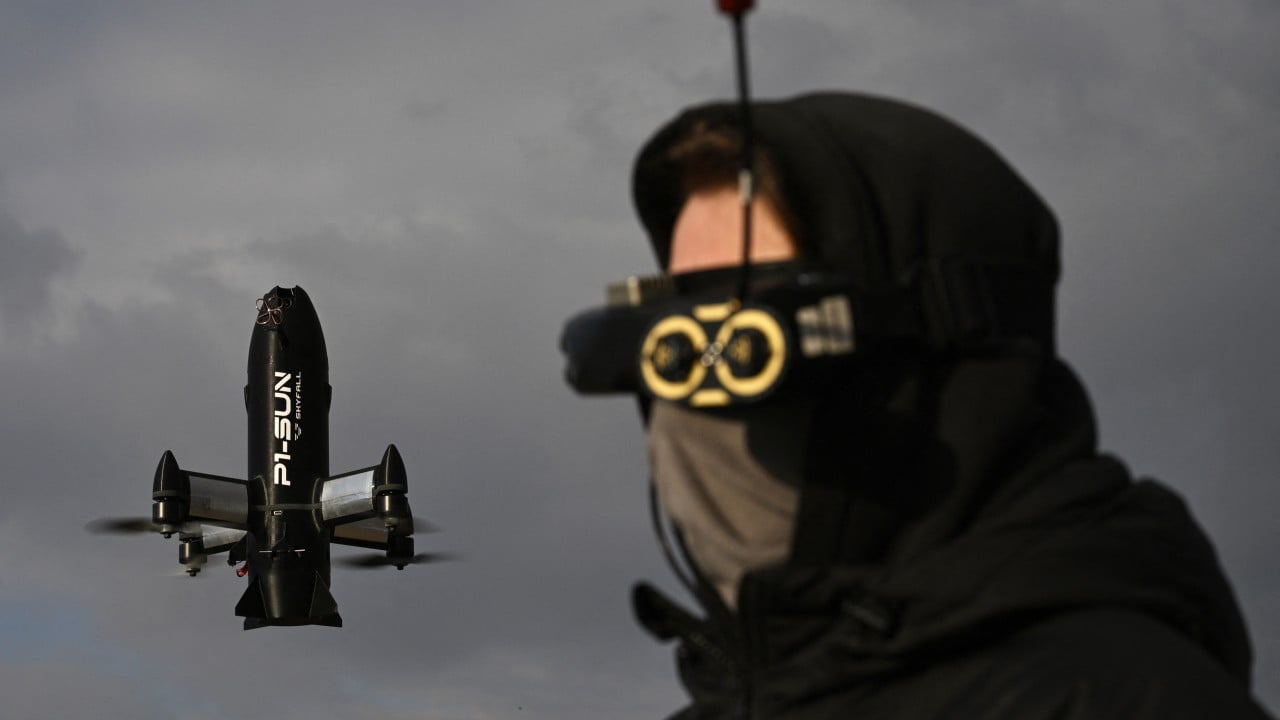
Defence Minister Shinjiro Koizumi confirmed last Friday that Japan had signed a contract to acquire interceptor drones from Ukrainian start-up SkyFall.
The company’s combat-tested P1-SUN family is designed to intercept unmanned aerial systems, including reconnaissance and attack drones, but Tokyo has not disclosed which model it ordered.
The acquisition follows Japan’s fast-track mass-procurement contract for the Terra B1 interceptor from Japanese company Terra Drone, which has also invested in two Ukrainian drone manufacturers to tap into their military technology and combat experience.
01:36
China slams Japan’s first overseas missile launch in 80 years
Hirohito Ogi, a senior research fellow at the Institute of Geoeconomics and a former Japanese defence ministry official, described Tokyo’s approach as a “two-phase” strategy of acquiring foreign systems to address urgent capability gaps while simultaneously developing domestic alternatives over the longer term.
Some overlap between the two was acceptable to avoid capability gaps during the transition.
He identified weaknesses in one-way attack drones and AI-enabled operational support systems, saying Japanese manufacturers had technical expertise but lacked know-how gained from “real-world battlefield experience”.
Beyond drones, Edgewing, a joint venture of Japanese, British and Italian defence companies, plans to open a design and development centre in Japan next year for a next-generation fighter programme.
According to Japanese news service Nikkei, the Aichi prefecture facility could eventually employ around 1,000 people.
Taken together, these developments point to a broader shift in Japan’s approach to military modernisation.
Tokyo has long acquired foreign-made weapon systems, mainly from the United States, but in recent years it has also sought partners elsewhere for advanced technology, joint development, production and maintenance.
Its 2026 defence white paper highlights pressures on the country’s defence-industrial base, including limited production volumes and companies withdrawing from the sector.
It advocates international research and development, licensed production and advanced foreign technology, while Japan’s Defence Buildup Programme calls for shorter development timelines to field urgently needed equipment faster.
Underpinning this shift is Tokyo’s stark assessment of regional security, with the white paper labelling Beijing’s growing military power and activities as Tokyo’s “greatest strategic challenge”.
Experts say closer cooperation with foreign defence companies could help Japan gain combat-tested technologies more quickly, share the costs and expertise required to develop advanced weapons, and expand its production and maintenance capabilities – potentially strengthening its ability to counter the People’s Liberation Army.
In a study released in July, Celine Pajon, head of Japan and Indo-Pacific research at the French Institute of International Relations, argued that foreign partnerships could ease Japan’s rising development costs, production constraints and dependence on US technology.
Her study linked a stronger domestic defence industry to Japan’s “strategic autonomy” and identified European countries as promising partners for joint development and technology-sharing.
02:45
Japan’s new arms export rules trigger Chinese warning against ‘moves towards militarism’
Defence expert Yoshihiro Inaba, the Japan correspondent for the Naval News website, highlighted gaps in uncrewed weapons, low-cost missiles and AI capable of “processing vast amounts of information”.
Companies such as Anduril, Palantir and General Atomics were among those supporting Japan’s efforts to address those shortfalls.
In its fiscal 2027 defence budget request, Tokyo proposed developing and acquiring low-cost stand-off missiles.
Inaba argued that importing such weapons could help Japan fast-track its long-range strike capabilities while developing domestic alternatives, without requiring major changes to Self-Defence Forces equipment.
He pointed to China’s growing “quantitative advantage” over Japan, including its fleet of “highly capable but expensive surface combatants”.
Japan could therefore improve its ability to counter these vessels by combining its existing domestically produced missiles with “a larger inventory of lower-cost cruise missiles”, supported by the surveillance and command-and-control systems needed to identify and target them, he said.
Still, even if larger stocks of inexpensive weapons helped Japan to counter Chinese warships, sustaining their use throughout a prolonged conflict would pose a separate challenge.
Misato Matsuoka, an associate professor at Teikyo University, cautioned that the bigger test was whether Tokyo could “produce, maintain and replace” military equipment on the scale needed during a prolonged conflict.
She noted that China’s much larger defence-industrial base gave it a capacity for expansion that Japan “cannot readily match”. While foreign partnerships could help address specific shortcomings, they would not eliminate the fundamental imbalance between the two countries.
Matsuoka also warned that Japan’s military preparations could reinforce Beijing’s perception that Tokyo and its partners were “preparing for confrontation”, deepening mutual mistrust.
Beyond these geopolitical risks, Japan would still face major industrial challenges. Foreign partnerships could accelerate technology transfers, Matsuoka said, but producing weapons “reliably at scale” required skilled workers, qualified suppliers and secure access to components and materials.
Reliance on foreign export approvals, software support and critical components could leave Japan vulnerable during a conflict with China, Matsuoka warned.
Japan could also struggle to sustain operations if it acquired systems it “cannot repair, modify or replenish independently”.
Ogi also cautioned that foreign defence companies’ growing presence in Japan did not necessarily reflect Tokyo’s military requirements. Such moves were “primarily motivated by the commercial interests of foreign companies”, he argued, as they anticipated further increases in Japanese defence spending.
For Japan, the challenge will be turning foreign technology and expertise into military capabilities quickly enough to address some of China’s advantages, while ensuring those systems can be maintained, produced and replenished if a longer conflict disrupts overseas supply chains.
“Foreign cooperation does not eliminate dependence; it redistributes it,” Matsuoka said.
KioskNews shows a cleaned-up reading view extracted from the publisher’s page — the original always lives on their site, not ours.