Milei earmarks about US$200 million for Argentina’s naval base in south
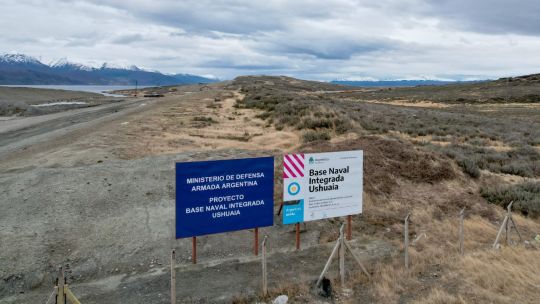
Argentina’s government will spend more than 300 billion pesos to build an Integrated Naval Base in Ushuaia, in the southern province of Tierra del Fuego, Defence Minister Carlos Presti confirmed on Friday.
The project, which the government says will strengthen Argentina’s strategic position in the country’s far south, is expected to be completed in 2029 and will be funded entirely with state resources, without external financing.
The total cost – expected to be around 300 billion pesos, or around US$200 million – will be included in the government’s 2027 Budget, which the Executive is due to submit to Congress for approval.
Defence Minister Lieutenant General Carlos Presti confirmed Friday that the entire cost would come “from the State’s own resources,” with no external financing involved.
“The government … has determined that, while maintaining fiscal balance, the resources are there,” Presti told the TN news channel during a visit to Ushuaia.
The minister said President Javier Milei had ordered that “facts, not words, be shown” and that the government should “push forward with the construction of this capability.”
“For 40 years everyone has looked the other way and no-one has made it a reality,” Presti said in the interview.
The project is one of a series of measures announced by President Milei earlier this month during a nationwide address on the Malvinas (Falkland) Islands, in which he renewed Argentina’s sovereignty claim over the islands and announced tougher measures against firms operating in the nearby waters.
The base is intended to strengthen Argentina’s strategic position in the South Atlantic and improve its capabilities in the region.
Milei said the facility would be used to increase Argentina’s telecommunications capabilities, while recent reports in local media have indicated that the government wants those systems to be integrated with radars, sensors, satellite systems and signals intelligence as part of a surveillance network covering the South Atlantic.
‘Argentine base’
Foreign Minister Pablo Quirno, who accompanied Presti on his trip south, noted the project will produce an “Argentine base using its own resources,” pushing back on the idea that the site would be used by foreign allies, such as the United States.
The project, which was initially conceived decades ago, is expected to be completed in 2029.
“After that, if countries join us and use our Integrated Naval Base for logistical purposes on their way to Antarctica, that is another matter, but today it is conceived as an Argentine base,” Quirno told TN.
Presti and Quirno visited the site where the Integrated Naval Base will be built, accompanied by specialists and technicians from the Armed Forces.
The officials also held a meeting with Tierra del Fuego's Peronist governor, Gustavo Melella, and Lieutenant Governor Mónica Urquiza.
The meeting took place at the Governor's Office. Melella expressed his “willingness to collaborate with the initiative,” said the government.
KioskNews shows a cleaned-up reading view extracted from the publisher’s page — the original always lives on their site, not ours.