‘Lotto ticket on four legs’: How to get your own Melbourne Cup horse
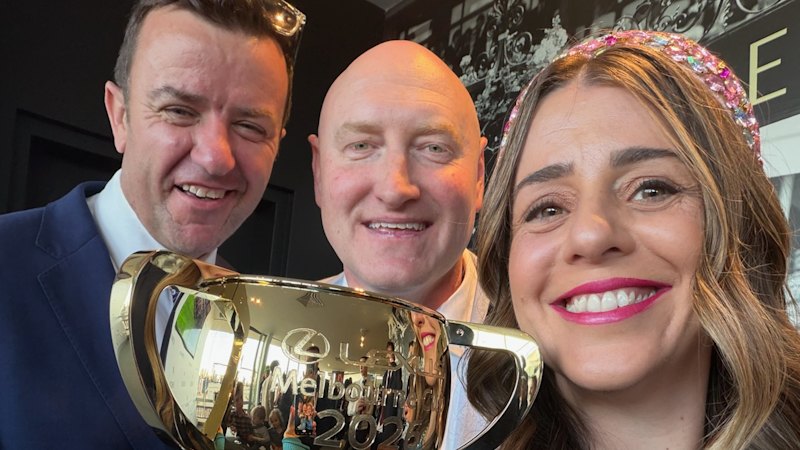
It’s taken 10 years and about 30 horses for Anya and Paul Podbury to find Shockletz, the Australasian-bred mare who will realise the Woodend couple’s lifelong ambition of owning a Melbourne Cup runner.
The first step in former Richmond footballer Justin Pickering’s path to Juja Kibo started during the COVID-19 pandemic, when he and a few mates landed juicy quaddies in Melbourne and Sydney on the same day.
Then there’s vet Rob McInnes, who got extremely lucky – then felt the wrath of the racing gods. He liked the horse he was inspecting so much, he bought a share. That horse was Defiantly, one of the favourites in this year’s great race – until his withdrawal on Saturday morning.
Of all the cherished items in Australian sport – think the premiership trophies of the AFL and NRL or cricket’s baggy green – the Melbourne Cup is the one that is attainable to the average punter. Theoretically.
Deep pockets help, of course, but through racehorse syndication everyday mums and dads with the unfashionably bred horse can knock off the bluebloods of the rich and famous.
As has become the norm over the past 15 years or so, this year’s field has predominantly come from Europe, arriving on these shores after being bought by bloodstock agents for leading syndicators and owners.
Jamie Lovett, a director for one of the country’s biggest syndication companies Australian Bloodstock, spends hours watching replays from races in Europe, studying form and cross-referencing times and measurements.
He also has a global team of about eight or nine, mainly on the ground in Europe, including jockeys and trackwork riders, who feed him intel.
“There’s a lot of tentacles to the business to try and land on the right horses,” Lovett said.
Based in Australia, he does not see many of the horses he buys in the flesh. That, he said, is the job of his vets. Once a horse is identified, Lovett approaches its owners or buys it at sales. He bought a few just last week from the Tattersalls sales in the UK.
Australian Bloodstock, which generally has about 100 to 150 thoroughbreds at a time on its books, has had two Cup winners in its silks – Protectionist (2014) and Gold Trip (2022), both from Europe.
The European imports do not come cheap, their price tags swelled by the demand from Australian interests desperate to find a cups horse, and the market in the Middle East searching for talent to run at Dubai’s lucrative World Cup meeting.
Gold Trip, who had come fourth in France’s famous L’Arc de Triomphe in 2020, cost about $2 million, which, at the time, was the most expensive horse Lovett had bought.
Australian Bloodstock have three runners in this year’s race – Royal Supremacy, Vauban and Wine Dark Sea. A fourth, the aforementioned Defiantly, failed a vet test.
Royal Supremacy, bought as a three-year-old after a third in the Italian Derby – one of Europe’s lesser derbies – “wouldn’t have been top of the top”, Lovett said.
“You’re not buying for $200,000 to $300,000, put it that way,” Lovett said.
In a cruel irony for those involved with Defiantly, a half-brother to last year’s Cox Plate runner-up Buckaroo and Melbourne Cup placegetter Middle Earth, the gelding had impressed McInnes so much during an inspection for Australian Bloodstock the vet shelled out $18,500 for a 2.5 per cent share.
“He was sound, beautifully natured, and everything was clean with his X-rays,” McInnes said before Defiantly’s withdrawal. “His demeanour was good.”
Presciently, he had also likened owning a horse to having a “Tattslotto ticket on four legs”.
Pickering, then, has found the winning ticket three times. That’s how many of the dozen or so horses he has part-owned who have run in the Cup. The former Richmond wingman played his 59 V/AFL games in the 1980s and ’90s, long before the money could set you up for life.
McInnes’ in was through his vet work. Pickering’s came through a friend of a friend.
He is part of several syndicates, many run by his mate Gerard Mulcahy, who lives next door to Mick Johnston and his wife Alise. Mulcahy often gets tipped into horses from the Johnstons, and relays the information to Pickering and his friends.
Their foray into racehorse ownership started during the many COVID-19 lockdowns when he and his friends started punting together to stay connected. After one particularly successful day, they decided to plunge their winnings into a horse.
It landed them in an imported stayer called Delphi, who won the Herbert Power in 2021 on his way to seventh in that year’s Melbourne Cup. They kept rolling their slice of the prizemoney into more horses.
“We occasionally take a dividend just to prove to our wives that it is profitable with racehorses,” Pickering joked.
Their next star was another European stayer, Circle Of Fire, who won the 2024 Sydney Cup, worth $1.3 million to the winner. He ran sixth later that year in the big one.
Their latest horse is Juja Kibo. There are 15 in the Happy Hippo syndicate who splashed out about $30,000 – or about $2000 each – for a 10 per cent share in the Ciaron Maher-trained gelding. They have even produced their own merchandise – stubby holders and ties adorned with Juja Kibo’s distinctive racing colours.
Many of them were at Flemington on Cox Plate Day when the six-year-old booked his ticket into Tuesday’s race with victory in the $750,000 Moonee Valley Cup.
“It was so good – you turn around and hug one of your best mates,” Pickering said. “It’s not going to be good for my health if he happens to win. I’m willing to take that risk.”
They were back at headquarters on Saturday night for the barrier draw, cheering loudly when their stayer drew gate 14 of 24. It’s been a nervous few days for Pickering, his wife Sally, and the Happy Hippo syndicate.
“For some reason, this one’s keeping me up at night just thinking about it,” Pickering said. “I’ve loved the way he’s gone about it and genuinely think he’s a fair chance.”
The Podburys have gone down a different route to finding their Cup runner. Folk like them are racing’s lifeblood – passionate owners who love sharing the thrill of raceday with friends and family.
They have part-owned about 30 horses – just a few per cent each time. Several have been with prominent owner Laurence Eales, who won the 2009 Melbourne Cup with Shocking and owned the cult hero Whobegotyou. The Podburys’ best is sprinting mare Benedetta, who won Adelaide’s group 1 Goodwood in 2024 and banked nearly $2.4 million in her career.
They bought into Benedetta with the prizemoney won by another of Eales’ horses Horrifying, a son of Shocking who banked about $300,000 in a month in 2022.
As the Podburys’ relationship with Eales grew, they were invited to lunch at South Melbourne’s O’Connell’s Hotel to discuss a 10 per cent share for $7500 in Horrifying’s unraced sister, which he had bred in New Zealand. That filly was Shockletz.
There are seven in the Podburys’ Plodalong – Zelt syndicate, each paying just over $1000 for a share in a mare that is one of the leading chances in the race.
The beauty of buying an untried horse, such as Shockletz, is the lower cost, though the risk is higher as there is no exposed form to assess.
Like the major syndicators purchasing stock from Europe, Paul, an accountant, studies form and watches trials as part of his due diligence before buying. On this occasion, he bought on trust from their positive experience racing with Eales.
“You’re not guaranteeing a collect, but you’re buying a known commodity to a certain extent, you know there’s some ability there, rather than buying a two-year-old stayer,” Paul said. “We were pretty lucky.”
As the saying goes, the best way to make a small fortune in racing is to start with a large one. Asked if they are ahead financially, Anya says: “yes – with gritted teeth”.
“If you did it for money, it would be unwise. You have to be prepared to invest knowing you may not get money back,” Anya said.
For the Podburys, it’s the romance of the turf. Anya has loved the Cup since she was a kid watching the race at primary school in Port Fairy.
“This is 10-year-old Anya talking now,” she said. “I dreamed of playing for Hawthorn, which in the ’80s and ’90s was not possible, and the other dream was having a runner in the Melbourne Cup.
“The people who own Shockletz, we’re normal, average people who work every day, have families and kids. We live a conservative lifestyle, we don’t go overseas; our treat is racing. It absolutely can happen to the average person. That’s the magic of it.”
Read more from our racing coverage
- Form guide: See Michelle Payne’s Melbourne Cup tips
- How to pick a winner: Bluffer’s guide to punting
- ‘Fearless’: How young jockey overcame death threats and abuse
- Blinkers On: This horse is barred after failing a drug test the trainer requested
KioskNews shows a cleaned-up reading view extracted from the publisher’s page — the original always lives on their site, not ours.