Why China’s ties with Serbia face scrutiny, not severance, after historic Vucic loss

Massive crowds, fireworks and dancing have filled the streets across Belgrade since Serbia’s nationalist strongman Aleksandar Vucic conceded defeat in Sunday’s parliamentary election after 14 years in power.
The political shift could cool diplomatic ties between Beijing and Belgrade and invite sharper scrutiny of Chinese investments in Serbia, but was unlikely to upend a relationship built on years of cooperation, they argued.
Vucic conceded the defeat of his right-wing Serbian Progressive Party to a grass roots movement called Students’ List about an hour and a half after polls closed, setting off waves of celebrations around the country.
The student-led movement, which started in 2024, consists largely of people outside the country’s established political parties, including university professors, doctors, farmers and cultural figures.
It built its mandate around tackling domestic challenges, prioritising institutional transparency and fighting corruption, breaking little ground from Vucic’s party on issues like ties with Russia and the EU, or the status of Kosovo, which declared independence from Serbia in 2008.
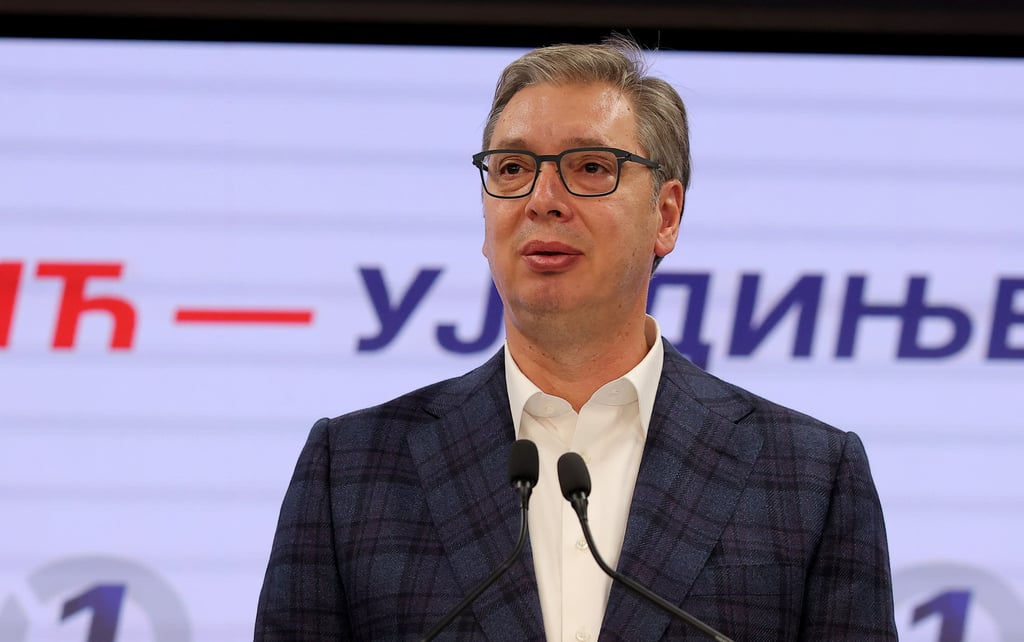
Vucic had been an “ironclad friend” to China, making his first state visit to Beijing in May and signing more than 20 deals covering cooperation in politics, trade, tech, education and cultural exchanges.
Four months later in September, Vucic stepped down from the term-limited role as president to lead his party and run for prime minister, a post he had hoped to reclaim in Sunday’s vote.
Cui Hongjian, director of European Union studies at Beijing Foreign Studies University, said the fall of Vucic did not guarantee a clean break from the past. It remained to be seen whether Serbia’s political landscape would enter an era of stability or remain locked in a protracted tug of war.
Vucic’s party still stands as Serbia’s second-largest political power and there remains a “real question mark” over whether the anti-Vucic forces can form an effective governing coalition, he added.
Both the motivation and the leeway for the incoming government to drastically shift its China policy remain limited. Serbia’s room for manoeuvre in its great-power balancing act has narrowed sharply in the wake of the war in Ukraine, according to Cui.
While the West has long viewed Serbia under Vucic as a close partner of Moscow, Belgrade insists it remains committed to joining the EU, even as it has refused to join European sanctions against Russia.
The incoming government faces a “tough situation where their choices are quite limited”, Cui said.
“Over the years, China and Serbia have forged deeply intertwined economic interests and a solid foundation of cooperation … Given the tangible benefits these ties deliver, is there any real incentive for the incoming government to disrupt a China policy – and a bilateral architecture – that has served the country so well?”
03:51
Xi Jinping hails ‘new chapter’ for China’s relations with Serbia as Belgrade backs his global vision
Cui’s view was echoed by Vuk Vuksanovic, a lecturer in foreign policy and grand strategy education at King’s College London, who also noted that geopolitical alignment and great-power influence had played a smaller role than in any Serbian election in decades.
Sunday’s vote was primarily fought over domestic issues, making foreign policy the area most likely to be “least susceptible to change”, in Vuksanovic’s assessment.
The China-Serbia partnership “has considerable potential to endure, as the new government in Belgrade will recognise China’s growing geopolitical weight and remain attracted by the economic opportunities it offers”, he said.
“The major challenge for Serbia, as for many other countries, will be navigating Sino-American rivalry, but that is a longer-term challenge.”
Stefan Vladisavljev, a visiting fellow with the China Observers in Central and Eastern Europe, cautioned that the student movement’s push for greater oversight of public contracts could bring heightened scrutiny to Chinese investments in the country.
The movement’s 11-point election manifesto called explicitly for full transparency of public procurement and auditing of state projects.
“While [Students’ List] is not saying that they will stop cooperating with China, it might be that the new rules and standards that will be set by the new government serve as a sort of deterrence to new projects between the two sides,” Vladisavljev said.
He pointed out that the student-led movement also pushed for stricter labour and environmental regulations – areas where Chinese operations in Serbia have faced frequent controversy – and would be more rigorous in setting rules and standards.
It was the 2024 collapse of a concrete canopy at a renovated railway station – a flagship project of China’s Belt and Road Initiative in Europe – that ultimately led to the formation of Students’ List.

The collapse, in the northern city of Novi Sad, killed 16 people and fuelled two years of nationwide protests that culminated in the movement’s election victory on Sunday.
Both Vucic and Beijing said the collapse had nothing to do with work done by Chinese companies. However, there were also allegations that two contractors were involved in inflating invoices on the project last year.
In May, Beijing’s embassy in Belgrade dismissed allegations that Vucic had promised that the Chinese consortium renovating the Novi Sad railway station would be shielded from accountability over the deadly incident.
Vuksanovic in London predicted that the new Serbian government would still “preside over a middle-income economy that needs investment and infrastructure development”.
“It may seek to renegotiate some existing contracts with Chinese partners to ensure greater compliance with environmental standards, stronger labour protections and increased transparency,” he said.
“Chinese investments may therefore face greater scrutiny but the new government is unlikely to push them out.”
China is Serbia’s second largest individual trading partner and its single biggest country source of foreign direct investment, while Belgrade is a cornerstone of Beijing’s European strategy.
Serbia was the first country in Europe to join China’s initiative of a new global community that aims to redefine the norms of international cooperation around principles such as mutual respect, sovereignty and non-interference.
According to Cui in Beijing, China is observing for now to what extent the movement can truly become a governing party that can effectively lead Serbia, as well as whether its scrutiny of the Vucic administration spills over into foreign policy or remains confined to domestic issues.
He predicted some initial turbulence in bilateral ties while the new government seeks to set itself apart from its predecessor.
“In the short term, the political dimension of China-Serbia’s ‘ironclad’ ties could experience a noticeable cooling, or even turn frosty – which is, frankly, an unavoidable reality,” he said.
“While the practical foundation based on shared interests might stay the same, the emotional bonds and political trust could be put to the test.”
KioskNews shows a cleaned-up reading view extracted from the publisher’s page — the original always lives on their site, not ours.