'Sheep in the Box': A pointless, sweet story of grief, robots - review

Hirokazu Koreeda is a director who focuses on stories about people you enjoy spending time with. His characters are usually kind, relatable, and, for lack of a better word, nice.
Even when he tackles subjects like selling babies for adoption, as in Broker, or a family of petty thieves who exploit lonely, vulnerable people in his Palme d’Or-winning movie Shoplifters, most of his characters still have a likable core.
There’s nothing wrong with being nice, but it doesn’t usually mesh well with dystopian AI dramas, and so I was surprised to read that his latest film, Sheep in the Box, which opens in theaters throughout Israel on Thursday, tackles that subject.
It is about how a couple, grieving the loss of their young son who was killed in an accident two years before, decide to adopt an AI robot programmed to mimic their child.
If it sounds like the Steven Spielberg movie A.I. Artificial Intelligence (2001), that’s because it is. The Spielberg film went further than Sheep in the Box in telling the story through the eyes of the robotic child substitute, and it had a different tone.
A different era than Spielberg's AI film
That was at least partly because it was made in a very different era, one in which the robot, played by Haley Joel Osment, could seem cuddly and warm, and in which the idea of such a robot was simply science fiction, instead of something you would expect to become a reality any minute.
Spielberg’s film was a kind of reboot of Pinocchio with a robot who longed to be a real boy.
But Koreeda knows viewers are likely wary of the idea of an artificial child, so we feel stirrings of dread, or at least unease, from the moment the cute robot enters the picture.
Early on, Otone (Ayase Haruka, one of the stars of Koreeda’s most enjoyable films, Our Little Sister), an architect, receives a gift: a heart-shaped object from a company called REbirth that projects a butterfly hologram.
It creates robots of the deceased based on photos, videos, and audio clips. She finds out that her family is entitled to a free robot, as are all those whose loved ones were killed in accidents or were crime victims.
Otone’s husband, Kensuke (Daigo Yamamoto), a down-to-earth contractor, is skeptical that any machine can replace their son, Kakeru (Rimu Kuwaki).
He mentions to his wife that they have been approached by the REbirth corporation several times before and that he isn’t interested. But he finally agrees to attend the company’s presentation.
Once he sees how realistic this robot will be, he gives in. Going over all the old photos and videos to send to the company is a bonding experience for them.
The prospect of the robot is especially cheering for Otone, who is still crippled by her grief. She can’t think of anything but Kakeru and ignores her family's suggestions that she have another child.
Once the robot is created and programmed, they wait anxiously for it to arrive. Otone is instantly soothed when the robot is switched on, but Kensuke tells it to call him “Mister,” not “Dad.”
Otone wants to spend time with robot while Kensuke remains sports-focused
All Otone wants is to spend time with the child-substitute, while Kensuke remains absorbed in sports, which you sense has helped him get through the loss.
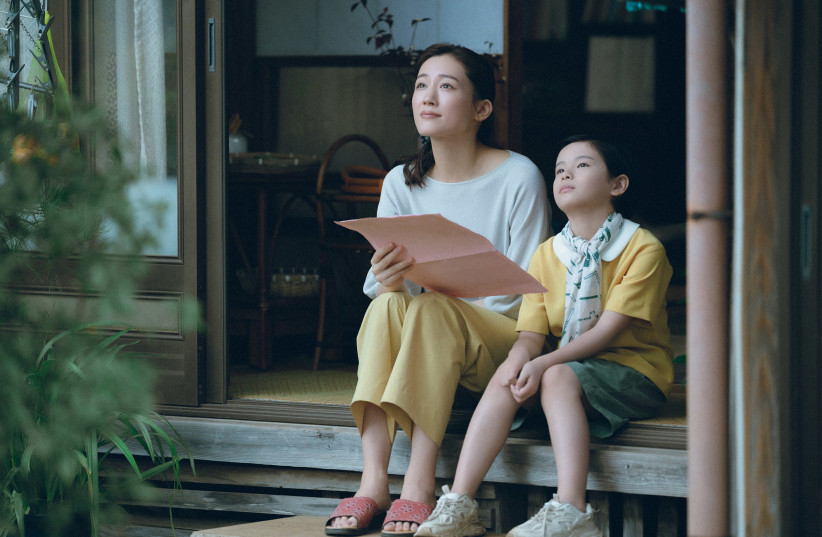
Their families and friends, especially Otone’s imperious, self-absorbed mother, are thoroughly creeped out, but Otone doesn’t care. Scenes show her looking beatifically up into the sunlight, the robot boy’s face beside hers.
But there are the stirrings of a subplot about other robot children who were rejected by their owners and sent back. These child-robots have bonded together in the woods to console themselves.
It also seems that their robot child keeps being drawn to the train tracks where their son was killed, which Otone finds alarming.
If you're hoping this will turn into sci-fi horror, you’ve got the wrong director, and the suspense-laden plot fizzles into a story that’s kind of nice. And somewhat pointless.
This will likely be the first time Koreeda fans are disappointed by one of his movies. Most of his films deal with the rupture of a family and the attempt to create a new one.
The lyrical film Our Little Sister, about three sisters who take in the daughter of their father from his second marriage, is a particularly moving example of this.
So is Like Father, Like Son, a drama based on those switched-at-birth cases that periodically make headlines, in which two sets of parents learn they must give up the child they raised for years and welcome their biological offspring, a complete stranger.
The title Sheep in the Box refers to a moment from The Little Prince by Antoine de Saint-Exupéry, where the little prince asks the aviator to draw a sheep and isn’t satisfied with his attempts.
Finally, though, the little prince is ecstatic when the aviator draws a box and tells him there is a sheep inside it.
I got the sense that in Sheep in the Box, Koreeda wanted to say something about how technology has started to replace human connection in our lives, but some sweetness in his vision of the world stopped him from scolding us too strongly.
Instead, he tries to help us understand why some people, like Otone, can be soothed by a box alone.
KioskNews shows a cleaned-up reading view extracted from the publisher’s page — the original always lives on their site, not ours.