Preserving an ancient mosaic: Israeli specialists gather to conserve 1,500-year-old synagogue floor
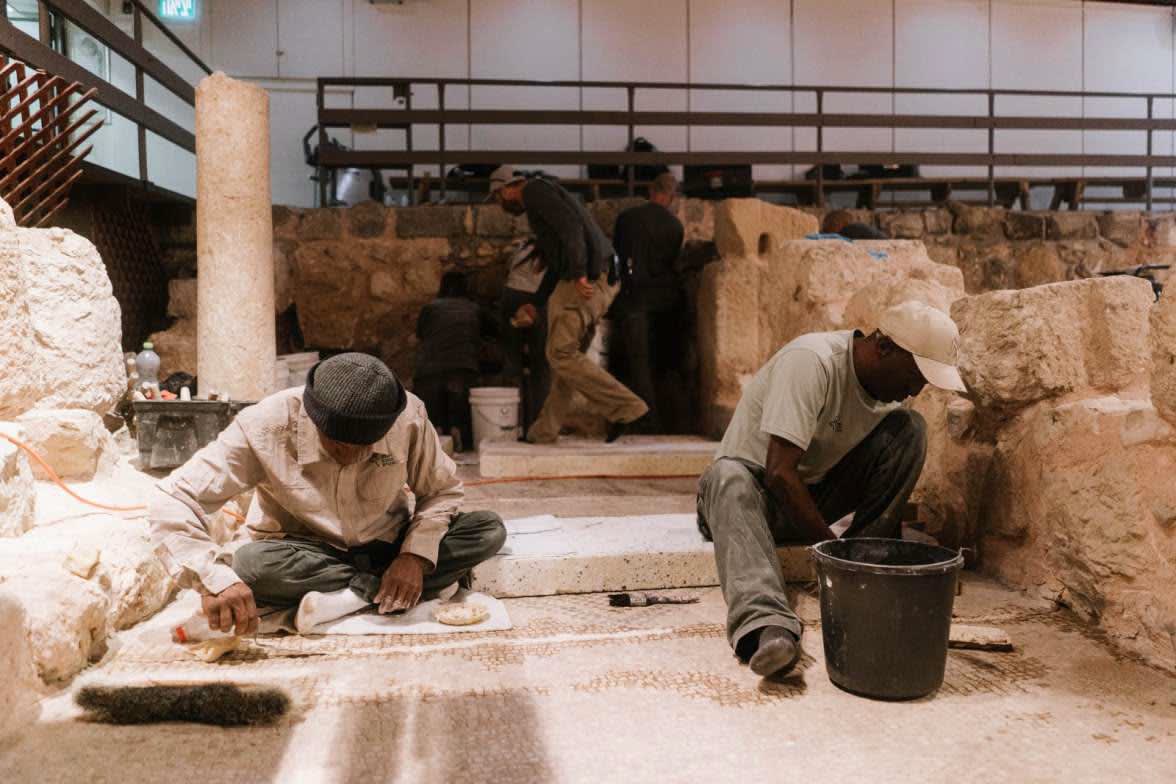
About 20 Israel Nature and Parks Authority (INPA) conservation specialists gathered at Beit Alfa National Park in northern Israel earlier this week to preserve the 1,500-year-old mosaic floor of the site’s ancient synagogue.
The team, led by INPA’s Archaeology and Heritage Division, was made up of specialists from across Israel.
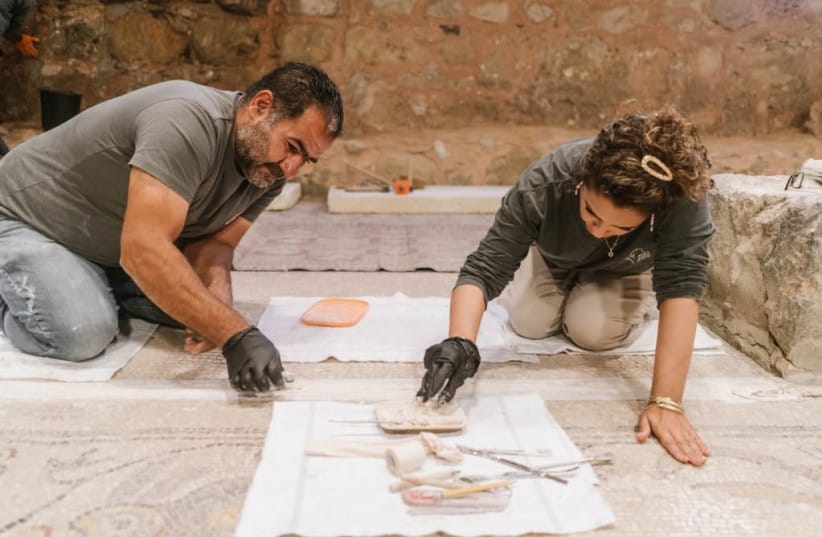
Together, they worked to gently clean the mosaic's surface, stabilize loose stones, and reinforce vulnerable areas, completing a task that would have otherwise taken several days.
Gaps between the stones were refilled with binding materials compatible with the mosaic’s original materials, a technique known as repointing.
Before and after the work was completed, the INPA documented the condition of the mosaic as part of its ongoing monitoring of the piece’s conservation and to aid in the planning of future maintenance.
What is the Beit Alfa mosaic?
Beit Alfa’s ancient synagogue was built during the Byzantine period, at the end of the fifth century CE, approximately 1,500 years ago. It is made up of a courtyard, corridor, rectangular main hall with the mosaic floor, a second-story balcony and an additional room.
An Aramaic mosaic inscription, most of whose right-hand section is missing, describes the floor as being laid during the “reign of Justinian,” thought to refer to Emperor Justinian I, who ruled from 527 to 565.
A second inscription, in Greek, names the mosaic’s artists, Marianus and his son Hanina. The two are also mentioned by name in an inscription at the synagogue in Beit She'an, suggesting that their workshop was located there.
The mosaic floor is split into three colorful panels, depicting the Ark of the Covenant, the zodiac and the biblical story of the Binding of Isaac.
The 12 signs of the zodiac appear in Hebrew, surrounding the Greek sun god, Helios, as he drives his chariot across the sky. A square frame surrounds the zodiac wheel, with a female figure in each of its four corners representing one of the four seasons.
The third panel features a depiction of the Binding of Isaac, showing a bearded Abraham holding a knife over his son - both identified by their Hebrew names. Above them is a hand, next to which are the words of God’s biblical command to Abraham, "Do not lay your hand," are laid.
The upper panel depicts the Ark of the Covenant, topped by a pediment containing a shell motif and birds, while seven-branched menorahs are depicted on both sides of its sides.
The panel also features a shofar, a fire pan, an etrog, lulav, and two lions.
Professor Eleazar Lipa Sukenik, an archaeologist from the Hebrew University of Jerusalem, uncovered the mosaic floor in 1928. Sukenik, notably, was among the first to recognize the importance of the Dead Sea Scrolls and aided the Israeli government in its efforts to purchase them.
His son, Yigael Yadin, became the IDF’s second chief of staff and a household name in Israeli archaeology, known for his work on the Dead Sea Scrolls, Masada, Tel Megiddo, and many other significant locations.
Preserving mosaic for future generations
"When standing in front of the mosaic floor at Beit Alfa, it is difficult not to be amazed by its beauty,” said INPA Archaeology and Heritage Division Director Orit Bortnik. “More than 800,000 tiny mosaic stones, laid side by side approximately 1,500 years ago, come together to tell a fascinating story about the people who lived here and the artists who created this extraordinary work.
"Our responsibility is to preserve this mosaic so that future generations can be moved by it just as we are. This special conservation operation is an excellent example of what can be achieved when dedicated professionals join forces.”
"In a single day, thanks to the participation of conservation specialists from across the country, we managed to carry out complex and significant work,” Bortnik said. “I am proud of the Israel Nature and Parks Authority's conservation teams, who work every day to protect the heritage treasures that belong to us all.
"This is also a wonderful opportunity to invite you to visit Beit Alfa, get up close to this remarkable mosaic, and discover firsthand just how much beauty and how many stories can be hidden within tiny stones."
KioskNews shows a cleaned-up reading view extracted from the publisher’s page — the original always lives on their site, not ours.