The big 'what if': Do those chanting 'from the river to the sea' really mean it? - opinion

How many times must we hear “Free Palestine from the river to the sea” at concerts, on university campuses, and city streets?
How many politicians, celebrities, and people of influence must repeat those words before we confront the question hiding in plain sight: What if they actually mean it?
Between the Jordan River and the Mediterranean Sea live approximately seven million Jews. Let us be clear: a Palestinian state replacing Israel across this entire territory is not suggesting a two-state solution.
What happens to the Jews who live there, some for generations?
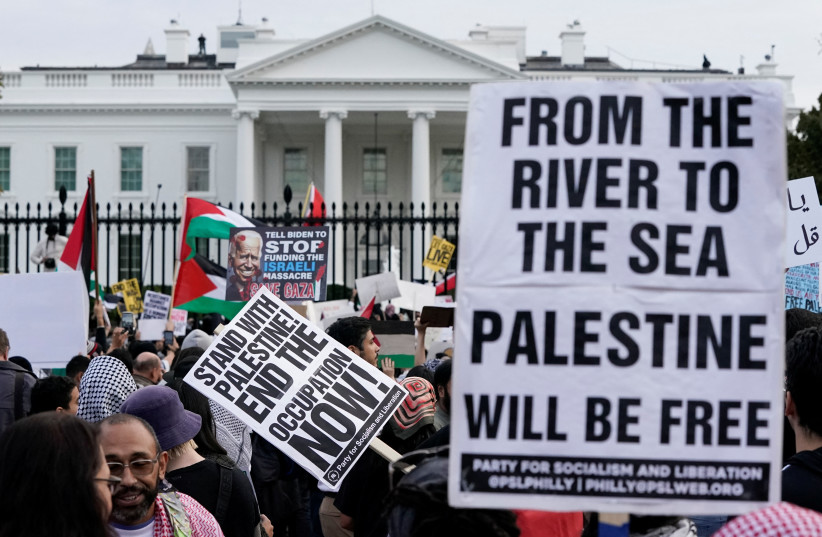
Where do they go? Who protects them? And what happens if they refuse to leave?
These are not hypothetical questions about a distant future. They concern the survival of a people whose history includes persecution, expulsion, and attempted annihilation.
Yet the international debate increasingly treats Israel’s elimination as a legitimate political aspiration without demanding an explanation of its consequences.
Consider the regional realities.
Israel is surrounded by Arab states that are not liberal democracies. The Palestinian Authority has not held a presidential election since 2005. Hamas, which seized control of Gaza in 2007, perpetrated the October 7 massacre.
In September 2026, the US again denied Palestinian President Mahmoud Abbas an entry visa for the UN General Assembly, citing objections to Palestinian leadership conduct. Abbas has also made statements widely condemned as Holocaust denial.
The PA and Hamas are the political institutions and movements against which promises of coexistence must be evaluated.
Israel withdrew its settlements and permanent ground forces from Gaza in 2005. Rather than creating a peaceful model of Palestinian governance alongside Israel, Hamas built military capabilities and ultimately launched October 7.
What credible guarantees would protect seven million Jews suddenly transformed from a sovereign majority into a vulnerable minority?
October 7 was not the whole plan
Evidence uncovered since October 7 makes this question considerably more urgent.
Hamas documents examined by The New York Times revealed that Yahya Sinwar sought to enlist Iran and Hezbollah in a broader assault against Israel.
In July 2023, a senior Hamas official discussed the planned attack with an Iranian Revolutionary Guard commander. According to the reported documents, Iran and Hezbollah welcomed the plan in principle but needed more time to prepare.
Sinwar proceeded.
Meanwhile, Israel subsequently exposed Hezbollah’s preparations for its own invasion of the Galilee.
The IDF reported discovering underground compounds, tunnels, weapons, motorcycles, and operational infrastructure intended to support attacks and military operations on northern Israeli communities.
How can anyone assess the foreseeable consequences of Israel’s elimination while ignoring the intentions and conduct of armed organizations seeking its destruction?
Three choices for seven million Jews
The first choice is departure, but to where?
At the 1938 Évian Conference, most participating countries refused to expand immigration opportunities for Jews fleeing Nazi persecution.
In 1939, the St. Louis, carrying more than 900 Jewish refugees, was denied entry to Cuba and the US. Forced back to Europe, many passengers subsequently perished in the Holocaust.
The second possibility is remaining under Palestinian sovereignty.
Would Hamas protect Jewish religious freedom? Would the PA guarantee Jewish property rights? What independent judiciary, police force, or military would protect Jewish communities against extremists?
The third possibility is resistance.
Millions of Israeli Jews could refuse to surrender their country and fight.
The consequences could include regional war, mass displacement, and catastrophic loss of life.
If a movement knowingly pursues a political objective whose implementation entails mass expulsion or destruction, can its proponents avoid scrutiny simply by calling their objective liberation?
Apply the same genocide standard
Israel has faced accusations of genocide in Gaza. Amnesty International’s December 2024 finding relied on officials’ statements, patterns of conduct, and cumulative consequences. Israel rejects the accusation.
The Genocide Convention requires specific intent to destroy a protected group, in whole or in part. That intent may be inferred from evidence; it need not be announced explicitly.
Now, apply the same methodology to a movement demanding Israel’s elimination.
Examine its rhetoric and the conduct of organizations pursuing that objective. Examine historical context, foreseeable consequences, and the willingness to accept mass harm.
If the intended outcome of “Free Palestine from the river to the sea” is the forced departure of seven million Jews, the issue is ethnic cleansing.
If the intended outcome includes killing Jews who refuse to leave, or deliberately imposing conditions calculated to destroy them as a group, the issue becomes genocide.
And if advocates knowingly accept such consequences, their declared objective of liberation cannot automatically absolve them of responsibility.
Intent cannot require inference when Israel is accused but suddenly require an explicit confession when Jews are the prospective victims.
Not every demonstrator intends genocide. But those demanding Israel’s elimination must explain how their objective could be implemented without mass expulsion, persecution, or killing.
Why does the Palestinian refugee problem endure?
Following the Holocaust, Jewish survivors were resettled, including in the newly established State of Israel.
Approximately 850,000 Jews left or were expelled from Arab countries and Iran in the decades surrounding Israel’s establishment. Many were absorbed by Israel despite enormous challenges.
The Palestinian refugee question followed a different trajectory.
UNRWA began operations in 1950, serving approximately 750,000 refugees. Today, approximately 5.9 million people, including descendants, are eligible for its services.
Why has a permanent solution proved so elusive?
Could the enduring refugee problem itself have become a strategic instrument in the long-term struggle against Israel?
Harder to understand is why so many in Europe and America have embraced demands framed around eliminating the one Jewish state among a multitude of Arab states.
Diaspora Jews
The danger does not stop at Israel’s borders.
Israel has sovereign institutions, intelligence services, and an army. Diaspora Jews depend on their host governments for protection.
In America, the warning signs are unmistakable.
According to the American Jewish Committee’s 2025 survey, published in February 2026, 91% of American Jews said violent antisemitic attacks had made them feel less safe. Thirty-one percent reported personally experiencing antisemitism during the preceding year.
CNN’s July 2026 analysis found that Israel’s average net favorability had fallen from plus 51 during Trump’s first term to minus 16, a staggering 67-point reversal.
Among Democratic voters, sympathy for Palestinians now exceeds sympathy for Israelis by 60% to 16%.
For Israel, the implications extend to its diplomatic relationships. For American Jews, already confronting rising antisemitism, the changing environment raises additional questions about their security and place in American society.
History has repeatedly demonstrated what happens when Jews become politically powerless, and societies cease to protect them.
The Holocaust is not ancient history. October 7 was less than three years ago.
At the UN this month, the world is being asked to normalize political demands whose implementation could place millions of Jews in existential danger.
Those advocating peaceful coexistence must explain how to achieve it. Those advocating expulsion or destruction must be judged by the same standards applied to anyone threatening a protected population.
And those who chant without considering the consequences must confront the genocidal implications of their words.
Because the concern is no longer just simply what the slogan’s genocidal meaning is.
The concern is what happens if someone attempts to turn it into reality, as Iran and Hamas tried on October 7.
For those of us who laughed at the many demonstrators who couldn’t tell you which river and which sea, perhaps laughing was a very inappropriate response.
What if some of them really mean what they are saying?
The writer is a global strategist and a strategic adviser at the Jerusalem Center for Security and Foreign Affairs. Follow him on X: @jeffkahn2020
KioskNews shows a cleaned-up reading view extracted from the publisher’s page — the original always lives on their site, not ours.