Daily Briefing November 1: Why the first Jewish-Arab coalition failed
Welcome to The Times of Israel’s Daily Briefing, your 20-minute audio update on what’s happening in Israel, the Middle East and the Jewish world.
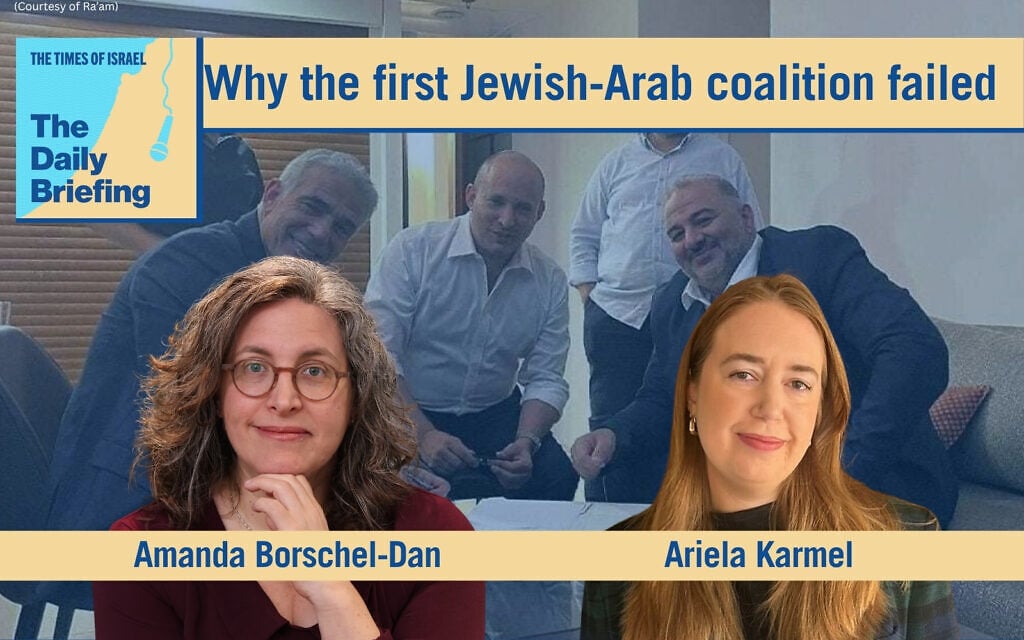
Political correspondent Ariela Karmel joins host Amanda Borschel-Dan for today’s episode.
WATCH the full episode here:
Yashar leader Gadi Eisenkot vowed Saturday to swiftly utilize the new Knesset’s parliamentary majority, declaring that Israelis had voted decisively against Prime Minister Benjamin Netanyahu’s government in last week’s election.
Anti-Netanyahu parties won 67 of the 120 Knesset seats, but of those, Zionist anti-Netanyahu parties won only 48, with the other 19 going to two Arab parties. Karmel explains how Eisenkot will likely get the first shot at forming a government and how, from the Knesset’s swearing-in on November 11, he vows to push forward his legislative aims — regardless of the governing coalition.
Around 2,000 people demonstrated on Saturday evening in support of a Jewish-Arab government in Tel Aviv. Borschel-Dan and Karmel discuss the obstacles to a possible coexistence coalition, which would be Israel’s second. Borschel-Dan points to the June 2022 legal gridlock over the continuation of the West Bank emergency regulations that led Naftali Bennett and Yair Lapid to dissolve that short-lived government.
Check out The Times of Israel’s ongoing liveblog for more updates.
For further reading:
Eisenkot vows to swiftly utilize Knesset majority ‘against Oct. 7 government’
Senior Arab MK says Joint List ready to back anti-Netanyahu government from outside
Subscribe to The Times of Israel Daily Briefing on Apple Podcasts, Spotify, YouTube, or wherever you get your podcasts. This episode was produced by Ari Schlacht.
Check out yesterday’s episode here:
Is our live election coverage important to you?
Are you relying on The Times of Israel for accurate and timely coverage of the 2026 Israeli election? If so, please join The Times of Israel Community. For as little as $6/month, you will:
- Support our independent journalists who are working around the clock to report political developments as they unfold;
- Read ToI with a clear, ads-free experience on our site, apps and podcasts; and
- Gain access to exclusive content shared only with the ToI Community, including our DocuNation streaming film series and weekly letters from founding editor David Horovitz.
Join The Times of Israel Community JOIN NOW Already a member? Sign in to stop seeing this
KioskNews shows a cleaned-up reading view extracted from the publisher’s page — the original always lives on their site, not ours.